
Your baby sleeps a lot. Or maybe not enough. Honestly, it is hard to tell when you are running on broken sleep yourself and every source gives slightly different numbers. The confusion is understandable — sleep needs shift quickly in the first two years, and what worked last month might already be outdated.
This guide breaks down exactly how much sleep babies need at every stage from birth through 24 months, based on guidelines from the American Academy of Pediatrics and the National Sleep Foundation. I have organized everything into a single reference chart plus age-specific details so you can find your baby’s current stage fast.
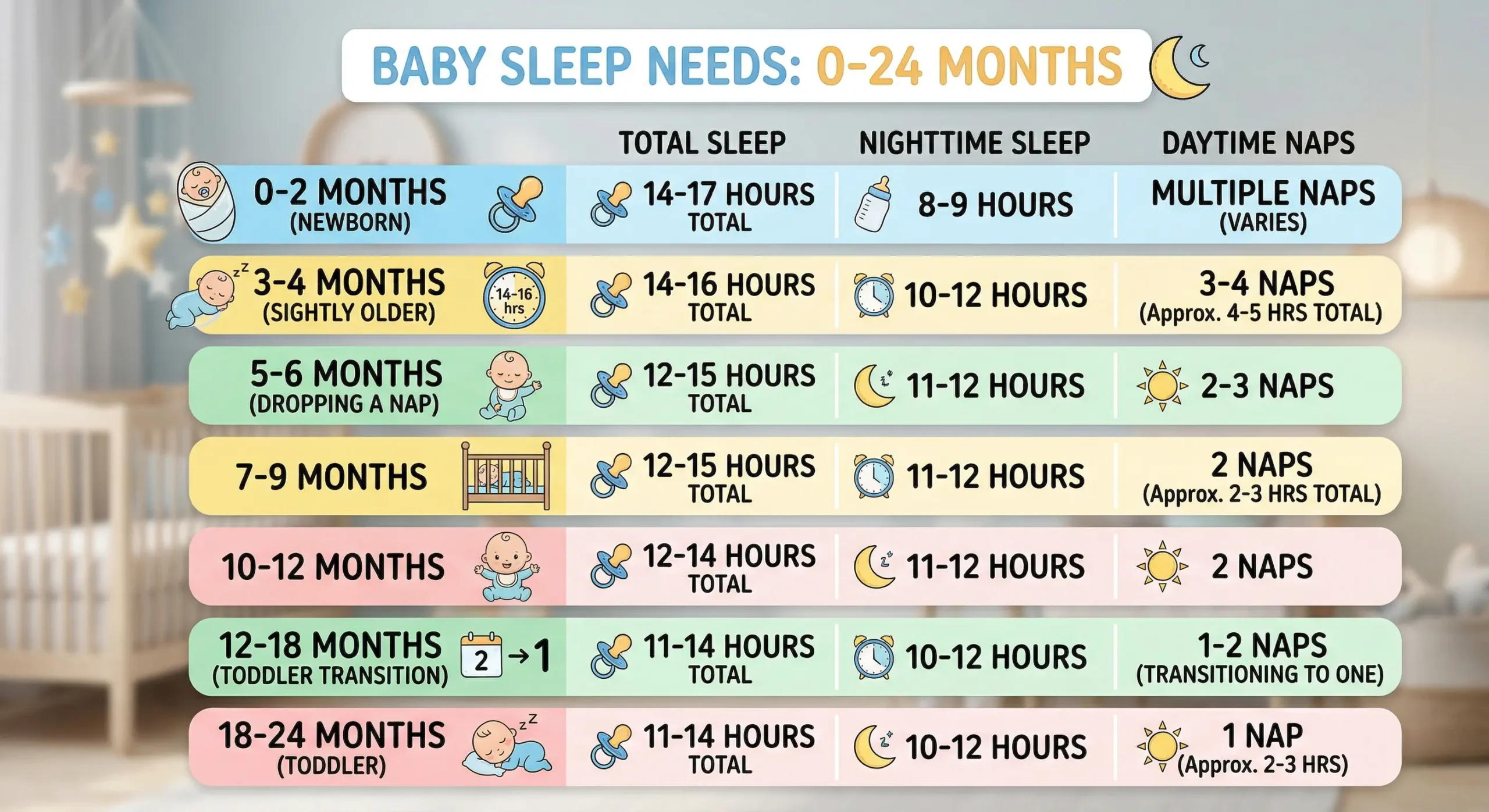
Total Sleep by Age — Quick Reference Chart
Here is the big picture. Total sleep includes both daytime naps and nighttime sleep combined.
| Age Range | Total Sleep | Nighttime Sleep | Daytime Naps | Wake Window |
|---|---|---|---|---|
| 🍼 Newborn (0–2 mo) | 14–17 hrs | 8–12 hrs | 6–8 hrs4–6 naps | 45 min – 3 hrs |
| 👶 3–4 months | 14–16 hrs | 9–11 hrs | 4–5 hrs3–4 naps | 1 – 3.5 hrs |
| 🧒 5–6 months | 13–15 hrs | 10–11 hrs | 3–4 hrs2–3 naps | 1.5 – 2.5 hrs |
| 🐣 7–9 months | 12–15 hrs | 10–12 hrs | 2–3.5 hrs2 naps | 2 – 3 hrs |
| 🚼 10–12 months | 12–14 hrs | 10–12 hrs | 2–3 hrs2 naps | 2.5 – 3.5 hrs |
| 🧸 12–18 months | 12–14 hrs | 10–12 hrs | 1.5–3 hrs1–2 naps | 3 – 5 hrs |
| 👣 18–24 months | 12–14 hrs | 10–12 hrs | 1.5–2.5 hrs1 nap | 4.5 – 5.5 hrs |
Keep this chart bookmarked. But remember — these are ranges, not rigid targets. Your baby might fall at the high end, the low end, or dead center, and all of those can be perfectly normal.
Newborn (0–2 Months)
Newborns typically sleep 14 to 17 hours in a 24-hour period, but it rarely feels like it because they sleep in short bursts of 45 minutes to 3 hours. There is no real schedule at this stage. Day and night confusion is common and completely normal.
I tracked my daughter’s sleep during the first six weeks using a simple notebook, and her longest stretch was 2.5 hours. Some days she logged 18 hours total. Other days barely 13. Both were within the normal range. The biggest lesson from those weeks: do not pressure yourself into building a “schedule” this early — it is not realistic and only creates frustration.
The priority at this age is not scheduling — it is safe sleep practices and feeding on demand.
3–4 Months
Sleep begins to consolidate. Most babies start producing melatonin around 3 months, which means longer stretches at night become possible. Total sleep is still 14 to 16 hours, but you will notice the pattern shifting: more sleep at night, fewer but slightly longer naps during the day.
We hit this with our son at exactly 3.5 months: after three weeks of sleeping 5–6 hour stretches, he suddenly started waking every hour. We did not panic — it genuinely passed on its own in about 10 days. Knowing it was temporary made all the difference in how we handled those nights.
This is also when the infamous 4-month sleep regression can hit. If your baby was sleeping well and suddenly is not, know that this is a temporary developmental leap. The brain is restructuring its sleep cycles — and that is actually a good sign.
5–6 Months
Most babies sleep 13 to 15 hours total and are settling into a more predictable nap pattern — usually three naps dropping to two by the end of this stage. Night stretches of 6 to 8 hours without feeding are common, though not universal.
My daughter needed to drop her third (late afternoon) nap around 5 months, but she would not do it on her own. We shortened that nap to 15 minutes and moved bedtime 30 minutes earlier. Within three days, her overnight sleep stretched by an extra 1.5 hours. Sometimes small adjustments create surprisingly big results.

7–9 Months
The two-nap schedule is usually well-established by now, with total sleep around 12 to 15 hours. Separation anxiety can cause temporary sleep disruptions around 8 months.
This was when our son realized I had left the room and started crying the moment I walked away. A gradual retreat approach — sitting by his crib for five minutes, then slowly moving toward the door over several nights — worked well for us. It took about two weeks to resolve completely.
An 8-month regression is common but typically shorter than the 4-month one.
10–12 Months
Sleep needs stay fairly stable at 12 to 14 hours total. Two naps of about 1 to 1.5 hours each. Some babies flirt with dropping to one nap around 11–12 months, but most are not truly ready until 14–15 months.
My daughter started refusing her morning nap at 11 months, so we assumed she was ready for one nap. We tried it for two weeks — evenings became a nightmare. We went back to two naps but shortened the morning one to 30 minutes, and everything fell into place. Do not drop a nap too early — even short naps still have value.
12–18 Months
The big nap transition happens here. Your toddler moves from two naps to one, usually between 13 and 17 months. Total sleep is 12 to 14 hours. Bedtime may need to shift earlier temporarily while the single nap lengthens.
During the transition, we did some days with one nap and some with two — letting our son decide based on his cues. This flexible approach worked surprisingly well. Some days he needed the extra rest, some days he did not. Staying flexible produced better results than picking a hard switch date.

18–24 Months
By 18 months, most toddlers are on a single midday nap of 1.5 to 2.5 hours with 10 to 12 hours of overnight sleep. The 18-month regression can make this stage rough — tantrums, boundary-testing, and a strong-willed refusal to go to bed are all typical.
Our son went through a phase at 19 months where he climbed out of his crib three or four times every night. We built a rock-solid bedtime routine (bath → book → song → lights off) and stuck to it without deviation. It took about 10 days, but the curtain calls stopped. At this age, routine really is everything.
How Sleep Needs Change as Babies Grow
The biggest shift is not the total hours — it is how those hours are distributed. Newborns spread sleep across the entire 24-hour cycle. By 6 months, most sleep has consolidated into nighttime with two structured naps. By 18 months, the pattern looks much more like an adult’s: one long overnight block plus a single daytime nap.
Understanding this trajectory helps set realistic expectations. A parent expecting their 6-week-old to sleep through the night is set up for frustration. A parent recognizing that nighttime consolidation happens gradually — and that their baby is right on track — can get through those early months with a lot less anxiety.
Signs Your Baby Is Getting Enough Sleep
A well-rested baby generally wakes up happy (or at least calm) after naps and in the morning. They can stay alert and engaged during wake windows without melting down. They fall asleep within 10 to 20 minutes at bedtime. Their mood is generally stable during awake time, and they hit developmental milestones without unusual delays.
No single sign is definitive. It is the pattern over days and weeks that tells the story.
Signs Your Baby Needs More Sleep
Watch for these: falling asleep in the car or stroller almost immediately, extreme fussiness at the end of every wake window, taking much longer than 20 minutes to fall asleep (overtired babies actually fight sleep harder), waking up crying from naps (short, unrefreshing sleep), and increased night waking.
If you are seeing several of these consistently, try adding 15 to 30 minutes to naps or moving bedtime 20 minutes earlier. Small adjustments often make a noticeable difference within 3 to 5 days.
Daytime vs. Nighttime Sleep Balance
A common mistake is letting daytime naps run long, which then pushes bedtime later or causes night waking. The balance matters. As a general rule, daytime sleep should make up roughly 30 to 40 percent of total sleep for babies under 6 months, and 15 to 25 percent for babies over 12 months.
If your baby is napping 5 hours during the day at 10 months but only sleeping 9 hours at night, the ratio is off. Shortening naps — especially the last nap of the day — can shift more sleep to nighttime.
When to Talk to Your Pediatrician
Most sleep variation is normal. But contact your pediatrician if:
- Your baby consistently sleeps far outside the ranges in the chart above (more than 2 hours over or under)
- Your baby snores loudly or has pauses in breathing during sleep
- Your baby seems excessively sleepy during wake times even when getting enough total sleep
- Sleep problems are significantly impacting the family’s well-being after trying schedule adjustments
The AAP’s guide on healthy sleep habits is a reliable starting point for understanding what falls within the normal range:
AAP — Healthy Sleep Habits: How Many Hours Does Your Child Need?

Frequently Asked Questions
It depends entirely on age. Babies under 6 months waking for nighttime feeds is developmentally normal. Most babies can sleep an uninterrupted 6–8 hour stretch between 6 and 9 months. But the definition of “sleeping through the night” in pediatrics is different from the adult version — doctors generally consider a 5–6 hour unbroken block as “through the night” for infants.
Typically 2 to 6 weeks. The most common regressions happen around 4, 8, 12, and 18 months. They usually coincide with major developmental leaps (rolling, crawling, walking, talking). The most important thing is to maintain your consistent routine — avoid starting new sleep training methods during these periods.
The three-to-two transition usually happens between 5 and 7 months, and two-to-one between 13 and 17 months. Most children drop daytime naps entirely between 2.5 and 4 years old. When your baby starts refusing a nap, do not drop it immediately — wait for at least 2 weeks of consistent refusal before making the switch.
No. Sleep training is a choice, not a requirement. It is a lifesaver for some families and completely unnecessary for others. If you are considering it, starting between 4 and 6 months is generally recommended. Talk to your pediatrician first to make sure it is appropriate for your baby’s situation.
Better sleep is usually not about one big change. It is about understanding where your baby is developmentally, setting up the right conditions, and making small, consistent adjustments.
Start with the chart above, then explore the age-specific guides on this site for a detailed schedule that matches your baby’s current stage.
This article is for informational purposes only and is not intended to replace professional medical advice, diagnosis, or treatment. If you have any concerns about your baby’s sleep, consult your pediatrician. This content is based on AAP and NSF guidelines.