
You fed the baby, burped the baby, changed the baby, and now she is screaming for no obvious reason. Except there is a reason — she has been awake too long. Missed wake windows are the single most common cause of naptime battles and bedtime meltdowns, and most parents have never heard of them.
Baby wake windows are the stretches of time your baby can comfortably stay awake between sleep periods. Get these right, and naps get easier. Miss them, and you end up with an overtired baby who ironically fights sleep even harder.
What Are Wake Windows?
A wake window is the period from when your baby wakes up to when they fall asleep again. It includes everything — feeding, playing, diaper changes, the entire awake period. Wake windows are measured from eyes-open to eyes-closed, not from when you start the nap routine.

The concept matters because babies have a biological limit to how long they can handle being awake. Stay within the window and the body produces sleep pressure (called adenosine buildup) naturally, making it easier to fall asleep. Exceed the window and cortisol rises, creating that wired-but-exhausted state that makes sleep nearly impossible.
I didn’t realize until my daughter was about 8 weeks old that a happy, smiling baby can still be tired. She would be wide awake, cooing and content — so I assumed she didn’t need sleep. About 30 minutes later, she would be overtired, screaming, and impossible to settle. Once I stopped relying on her mood and started watching wake windows instead, everything changed. Don’t wait for a meltdown — tired cues aren’t always obvious.
Baby Wake Window Chart by Age
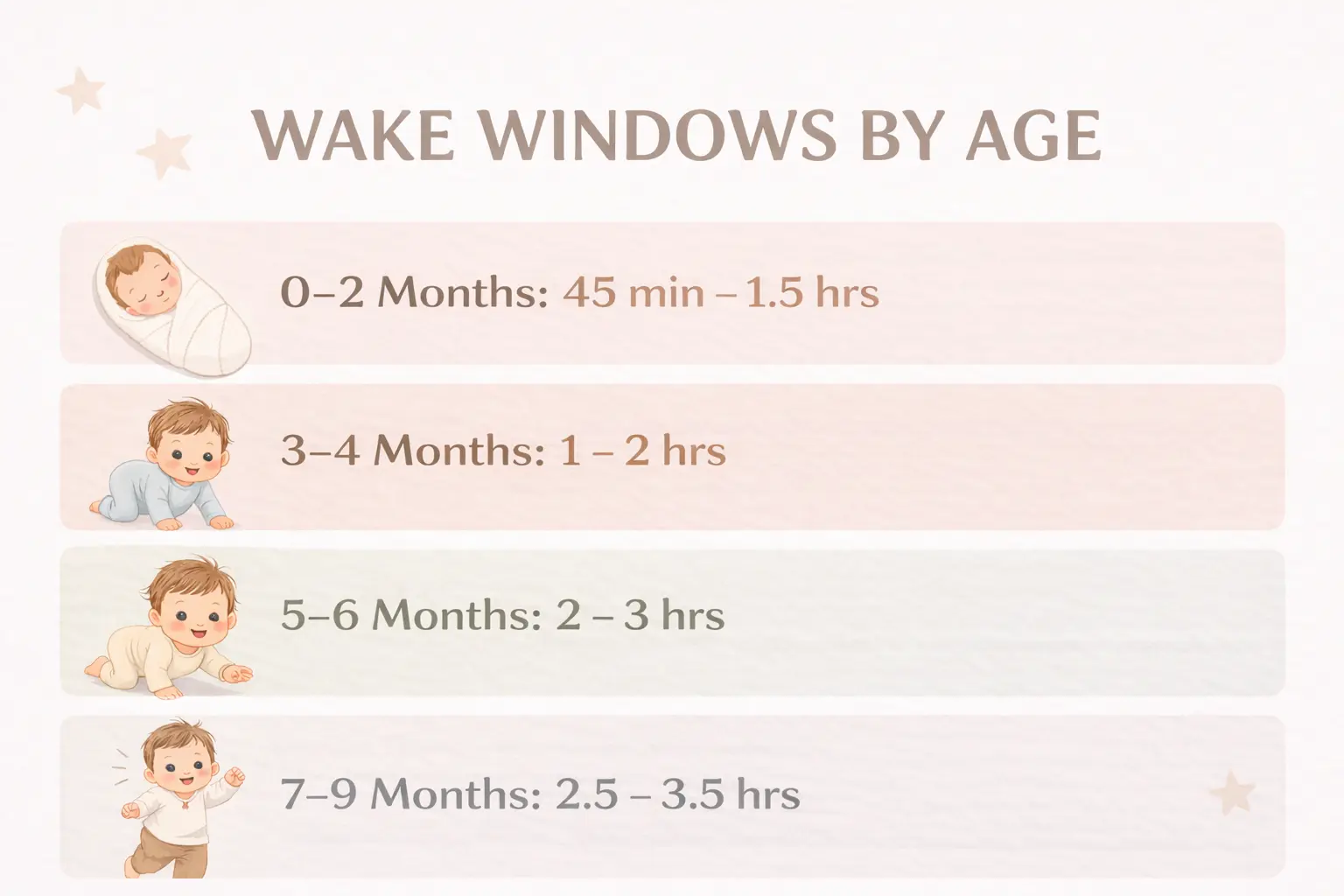
These numbers are averages. Your baby might run 15 minutes shorter or longer than these ranges and that is completely fine. The chart is a starting point, not a stopwatch.
| Age | Wake Window | Typical Naps | Notes |
|---|---|---|---|
| 0–2 months | 40–90 min | 4–6 naps | Shortest windows — err on the side of too short |
| 3–4 months | 75 min – 2 hrs | 3–4 naps | First window of the day is usually shortest |
| 5–6 months | 2 – 2.5 hrs | 2–3 naps | Third nap often drops during this stage |
| 7–9 months | 2.5 – 3.5 hrs | 2 naps | Pattern: shortest AM / medium midday / longest PM |
| 10–12 months | 3 – 4 hrs | 2 naps | Before-bed window reaches 4 hours |
| 12–18 months | 3.5 – 5 hrs | 1–2 naps | Messy 2-to-1 nap transition period |
| 18–24 months | 5 – 6 hrs | 1 nap | Schedule finally becomes predictable |
0–2 Months (Newborn Wake Windows)
Newborn wake windows are shockingly short. A 2-week-old might only tolerate 40 minutes of awake time before needing sleep again. I remember being surprised that by the time I had fed, changed, and done a few minutes of tummy time, the window was already closing. At this age, err on the side of too short rather than too long. An overtired newborn is much harder to settle than one who gets put down a few minutes early.
With my first baby, I thought “45 minutes awake” couldn’t possibly be enough — it felt way too short. I kept him up for an hour and a half, assuming he needed more playtime. He ended up crying for 40 minutes before finally falling asleep. With my second, I trusted the timing and set a phone timer for 45 minutes from the moment she woke up. She went down with almost no fuss. The difference was night and day. Don’t underestimate short wake windows — they can make all the difference.
3–4 Months
Wake windows stretch to about 75 minutes to 2 hours. This is when patterns start forming. The first wake window of the day (from morning wakeup to first nap) is often the shortest. The last window before bedtime may also be shorter than midday windows. Pay attention to which pattern your baby follows.
This was the age where I finally started noticing a consistent rhythm. My son’s sweet spot was about 80 minutes for his first wake window, stretching to around 1 hour 50 minutes later in the day. I tracked everything in a simple notes app for a week, and the pattern quickly became clear. Paying attention to timing instead of guessing made the whole day feel more predictable and manageable.
5–6 Months
Two to 2.5 hours is typical. Babies at this age are usually on three naps transitioning to two. When you drop the third nap, the last wake window before bed stretches, so bedtime may temporarily move earlier to compensate.
Dropping the third nap was a tough transition for us. My daughter’s last nap had always been a quick carrier catnap, and once we cut it, I had to move bedtime up to around 6:15 PM for a couple of weeks. It felt incredibly early at first, almost unrealistic — but she ended up sleeping through the night better than she ever had on the three-nap schedule. Sometimes an earlier bedtime is exactly what helps smooth the transition.
7–9 Months
With a solid two-nap schedule, wake windows run 2.5 to 3.5 hours. The pattern usually looks like this: shortest window in the morning (2.5 hours), medium window midday (3 hours), longest window before bed (3 to 3.5 hours).
10–12 Months
Three to 4 hours between sleep periods. The before-bed window is the longest of the day, often reaching 4 full hours. This is normal and helps build enough sleep pressure for a solid overnight stretch.
12–18 Months
During the two-to-one nap transition, wake windows shift dramatically. On two-nap days, windows might be 3.5/3.5/4 hours. On one-nap days, you are looking at 5 hours before the nap and 5 to 5.5 hours after. The transition period lasts 2 to 6 weeks and can be messy.
The 2-to-1 nap transition was one of the hardest phases for us. For about three weeks, my son bounced between needing two naps some days and just one on others. I had to pay close attention to his cues each morning to decide. What helped most was a simple rule: if he showed tired signs before 10:30 AM, we stuck with two naps; if he was happily playing past 11, we committed to one. It wasn’t perfectly consistent at first, but with patience, a clear pattern eventually emerged.
18–24 Months
Toddlers handle 5 to 6 hours of awake time between naps. A typical schedule: wake at 7 AM, nap at noon, wake from nap by 2:30 PM, bedtime at 7:30 to 8 PM. Straightforward, finally.
What Happens When Baby Wake Windows Are Too Long
An overtired baby shows specific signs: rubbing eyes aggressively, arching back, becoming hyper and frantic rather than calm, crying that escalates quickly, and taking 30+ minutes to fall asleep. The cortisol response kicks in, making the body fight sleep.
I tested this inadvertently when I pushed my son’s morning wake window 30 minutes past his limit for a pediatrician appointment. The resulting nap was 25 minutes instead of his usual 90, and the entire afternoon schedule collapsed like dominoes.
What Happens When Wake Windows Are Too Short
Putting a baby down before enough sleep pressure has built results in: playing in the crib instead of sleeping, fussing on and off without settling, taking a short nap (less than 30 minutes) because they were not tired enough for a full cycle, and bedtime resistance if the last nap ran too late.
I went through a phase where I was so worried about overtiredness that I started putting my daughter down too early. Instead of falling asleep, she would roll around, babble, and play with her sleep sack zipper — anything but sleep. Once I added just 15 minutes to her wake window, it made an immediate difference. Overtired isn’t the only issue — undertired can be just as disruptive.

How to Find Your Baby’s Ideal Wake Window
Start with the chart above and adjust. Extend by 10 to 15 minutes if your baby consistently plays in the crib before falling asleep (not tired enough). Shorten by 10 to 15 minutes if your baby is crying hard at the start of nap time (overtired).
Track the results for 3 to 4 days before adjusting again. Small changes need time to show their effect.
Also pay attention to sleep cues — yawning, staring blankly, turning away from stimulation, pulling ears. These signals confirm that the biological window is closing.
Understanding wake windows transformed how I approached my baby’s schedule. Instead of watching the clock for arbitrary nap times, I started watching the baby. The wake window chart gives you the framework; your baby’s behavior gives you the fine-tuning.
Frequently Asked Questions About Baby Wake Windows
No. The ranges listed in any wake window chart are averages based on developmental norms. Individual babies vary by 15 to 30 minutes in either direction. Premature babies may follow wake windows based on their adjusted age rather than birth age for the first 1 to 2 years. Use the chart as a starting point and adjust based on your baby’s cues.
For most babies between 3 and 12 months, yes. The first wake window tends to be the shortest because the body is still transitioning from overnight sleep. By around 12 to 18 months, as babies move to one nap, this pattern fades and the morning awake stretch grows significantly.
Nap transitions (4 to 3, 3 to 2, 2 to 1) are naturally inconsistent. Some days your baby will need the extra nap and some days they won’t. Watch for signs like resisting the last nap for 5+ days in a row, that nap taking longer than 15 minutes to fall asleep for, or the nap pushing bedtime too late. During the transition, alternate between schedules based on how the day is going.
Yes. Illness, teething, and growth spurts can temporarily shorten wake windows by 15 to 30 minutes. A baby who normally handles 3 hours might need sleep after 2.5 hours when fighting a cold. Follow their cues, shorten windows as needed, and return to the normal schedule once they recover.
Some babies are naturally higher or lower sleep-need than average. If your baby is happy, falling asleep within 10 to 15 minutes at nap time, sleeping well overnight, and waking rested — their wake windows are right for them, even if the chart says otherwise. The chart serves as a diagnostic tool, not a rule book.
This article is for informational purposes only and is not intended to replace professional medical advice, diagnosis, or treatment. If you have any concerns about your baby’s sleep or health, consult your pediatrician. This content is based on AAP and NSF guidelines.